Our mission is to provide professionally trained Civil Engineers for all type of civil engineering services. Increase the supply of efficient & highly skilled Civil Engineers and serve the Civil Engineering Community.
Read More
“Highway Drawings with CAD” course covers details process of drawing creation considering highways features as the prerequisite. Preparation of highway drawings, needs to use various xrefs such as highway xref, road marking xref, pavement xrefs, etc. The course provides a comprehensive process to create highway drawing from scratch to printing final PDFs. The first module provides the operation process of the X-ref manager. It provides all the details of subcommands within xref window and how to operate it. It also demonstrates the process to create an xref and how to attach it with other drawings. The second module provides an operation process of drawings sheet production. It covers the process to set the drawing layouts with xrefs and then provides the details of sheet layout setting along with printer setting. Lastly, it covers the printing PDF process to generate hard copy drawings. The third module runs a pilot to generate pavement drawings. it covers step by step process to create pavement xref, layer creation of each pavement types, sheet layout setting, title frame setting, legend, notes, scale setting and finally printing drawings as PDF process.
Read more
P-way Design involves the design, construction, operation and maintenance of Light Rail Transit (LRT), Heavy Rail Transit (MRT) and Highspeed Rail (Bullet Trains) to ensure safe and effective transportation of people and goods. The course modules share P-way or LRT Design in a detailed manner. The course has covered key industry of P-Way Design, Elements of P-Way such as LRV Bumpers, vehicle dynamic envelops, etc. The course module the design process track, horizontal design, vertical design, superelevation, the speed at curves, and track components, etc. The course also covers different type of Track Forms such as Ballasted Track Forms, Embedded Tracks. Along with this, the course covers key features of Tram Stop, type of stops, surface finish, etc. In the First Module, we have commenced the course with the key industry of P-Way Design. The module then explained the features of Tram like LRV vehicles, pantographs, crash energy management (CEM), LRV Bumpers, vehicle dynamic envelopes, platform clearance, etc. In the Second Module, we have described Track horizontal design and covers link and curve section design, superelevation or cant deficiency and superelevation unbalance. The course module has also described how to define the speed of LRT Track at curves and the categories of speed at curves such as overturning speed, safe speed, maximum authorised speed and signal speed. In the third module, we have described Track vertical alignment design and covers vertical gradient, crest curves, sag curves design along with design guidelines and design formulas. Thereafter, the module has described trackwork component such as Turnouts, Crossovers, Switches, Cross-Rails, Frogs, check-rails, and Pocket Tracks. In the fourth module, we have described LRT Track forms, stiffness of track, and track modulus. Thereafter, the modules have described various Track forms such as Ballasted Track, Direct Fix Track, Embedded Track, Floating Track and Tracks in the transition zone. The module has also covered various forms of Track Sleepers such as Timber Sleeper and Pre-cast concrete sleepers. The module described the formula to determine the spacing and factors of the sleepers that affect sleeper spacings. In the Fifth Module, we have described LRT Tram STOP design and its types like Island Platform and Side Platform. The Module then covers components of Tram Stop such as shelter, walkways, ramps, steps, signages, lighting, Passenger Information, etc. It has also covered the Platform surface finish and Tactile. In the Sixth Module, we have described the Tram signal system, signal equipment, traction power system, distribution system, substation system and catenary system. Within the Tram Signal System, we have covered the switch machine, impedance bonds, loops and transponders, wheel detectors, axle counters, etc.
Read more
If you are a MS Word novice and want to learn MS Word, this is the ideal course for you to start. The course gives you opportunity to learn MS Word from basics to advance levels. In the first module, you will learn about the following topics -creating word document, start-up window, quick access toolbar, MS Word Interface, Ribbons and Open/Save word file. In the second module, you will learn basics of entering texts, how to enter text. edit text, navigation text and word shortcuts. In third module, you will learn how to perform formatting in MS Word, bullet/ numbers, formatting texts, mini toolbar, MS word styles and custom word styles. In fourth module, you will learn page layout techniques. You will learn MS word margins, page breaks, orientation, header and footers, page background. In fifth module, you will learn spell checker, auto correct, find & replace and Printing process.
Read more
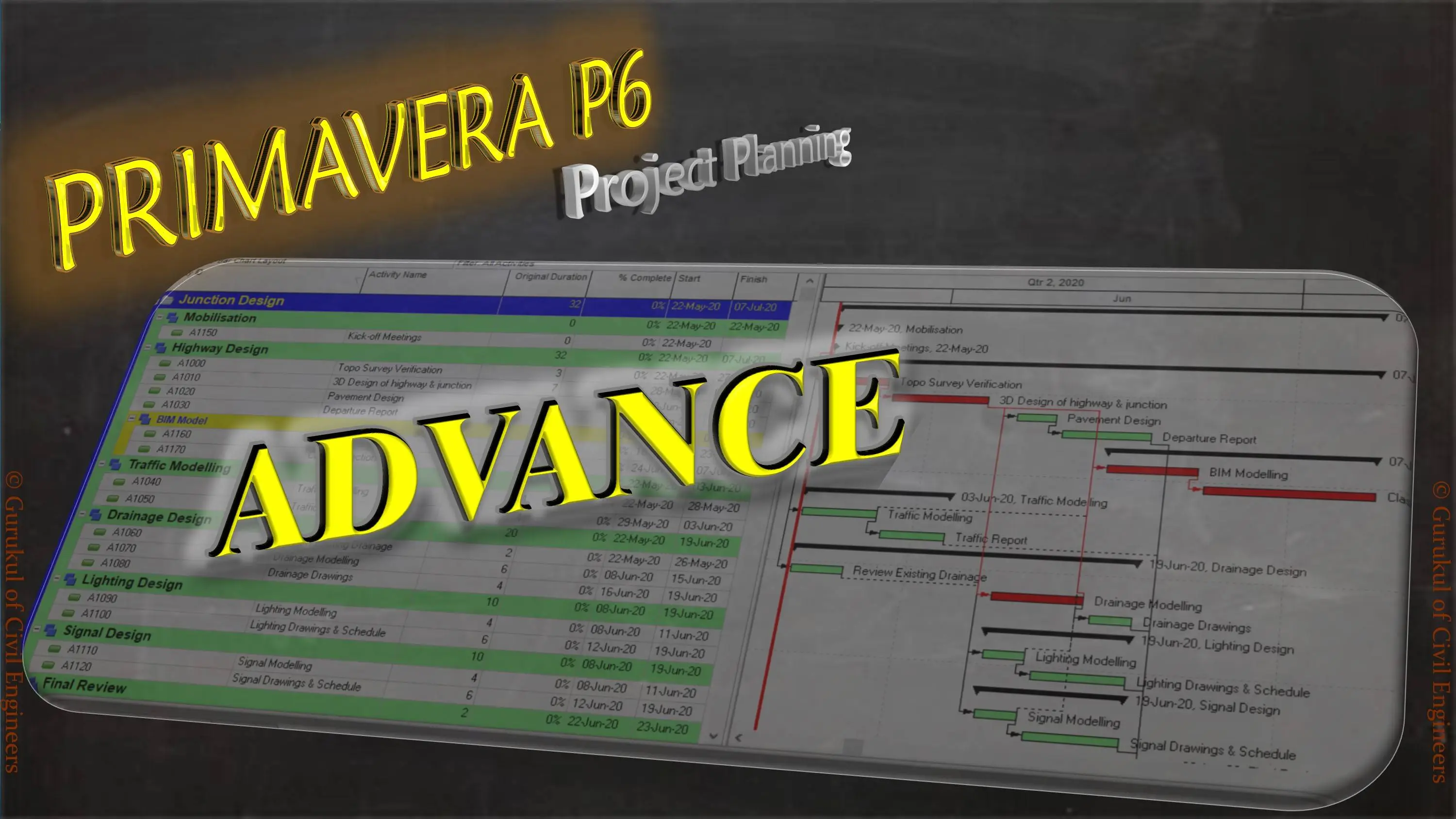
This is an advanced course explaining the comprehensive process of project planning using Primavera P6 as a tool. A hands-on civil engineering project program is developed showing step by step process so that students learn how to plan, analyze, and manage the project using Primavera P6. The first module provides a detailed process of moving a project forward and backward. It’s not unusual to see that the project commencement date moves forward and it’s very vital to know how to move the project program accordingly. The course also delivers a detailed process of setting a baseline of the program. This will assist Managers to monitor the project program as the project progresses. The second module discusses, project resources for each activity. This will help to determine overall project cost as well as the breakup of the cost of each task. This process helps project managers to optimize overall project costs for any bidding or tender activity. The third module discusses the process of assessing the percentage completion of each activity. Percentage completion can be provided by updating physical and duration completion. The fourth module covers the complete process of assessing critical path and total float within the project program. Critical Path analysis assist project managers to delegate more resources to complete those tasks in time. Float within the program helps project managers to chip-in a new task in the program without impacting the overall project duration. The fifth module provides details of printing various project reports such as project reports, cost reports, organograms, from the Primavera P6.
Read more
Dutch Style Roundabouts are one of the most innovative roundabouts that provide priority to pedestrians and cyclists without significantly compromising vehicular traffic movement. Our Dutch Style Roundabout course modules are designed to cover all key aspects of the design process. It covers the centreline design of all four arms, crown line of Roundabout, and then gradually develops road channels, cycle tracks, footway, crossing facilities, etc. The first module starts with verification of the Topographical Survey. Here, the module explains how to verify the topo survey and make it fit to use as Xref for roundabout design. The module also explains how to change the colors of individual layers to make Xref less prominent. The second module explains the design process of Roundabout crown line, road centrelines, channel line design, entry radius design, exit radius design, splitter island design. The proposed layout set the foundation of the roundabout footprint so that footway and cycle facilities are provided safely. The third module explains the design process of cycle facility design. A circulatory uni-directional cycle track is designed. Inbound and outbound cycle tracks are designed and connected to the circulatory. The fourth module explains the process of footway design and crossing facilities. The back edge of the footways plays an important role in tie-into the existing. Segregated pedestrian and cycle crossing facilities are proposed. It is highly recommended to provide a pedestrian crossing facility suitable for blind and partially sighted pedestrians, therefore tactile are proposed at all crossing points. The fifth module explains the process of creating a General Arrangement Drawing. The module details out how to call all required Xrefs and how to use sheet layout, title frame, etc to develop General Arrangement Drawings. Finally, the module explains how to create a PDF of the General Arrangement drawing.
Read more
Skill Improvement Leads to Employability:- GCE Evaluates & Provides a Detailed Performance Result.
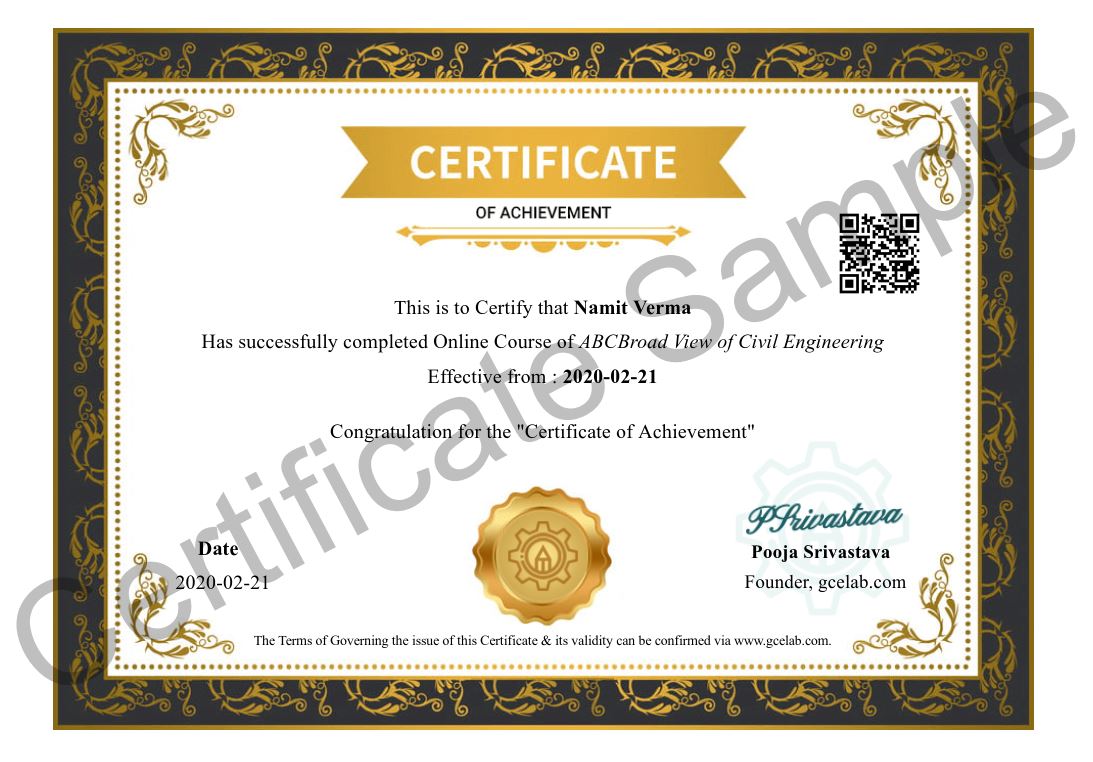
At GCE, we provide course completion certificates of all courses. Our certificate comes with unique QR Code to validate it online & download it whenever needed.
We build your CV with professionally designed Resume Builder Application. Our Resume Builder is not just another resume creation tool; it is the finest tool to present your career graph.


Our mission is to provide professionally trained Civil Engineers for all type of civil engineering services....
Copyright © 2026 Gurukul of Civil Engineers | All Right Reserved | Design & Developed By Ntier Infotech India.